MANCHESTER — The City of Pittsburgh is taking the first steps toward reuniting Manchester and Chateau, and is seeking public input on the best plan of action.
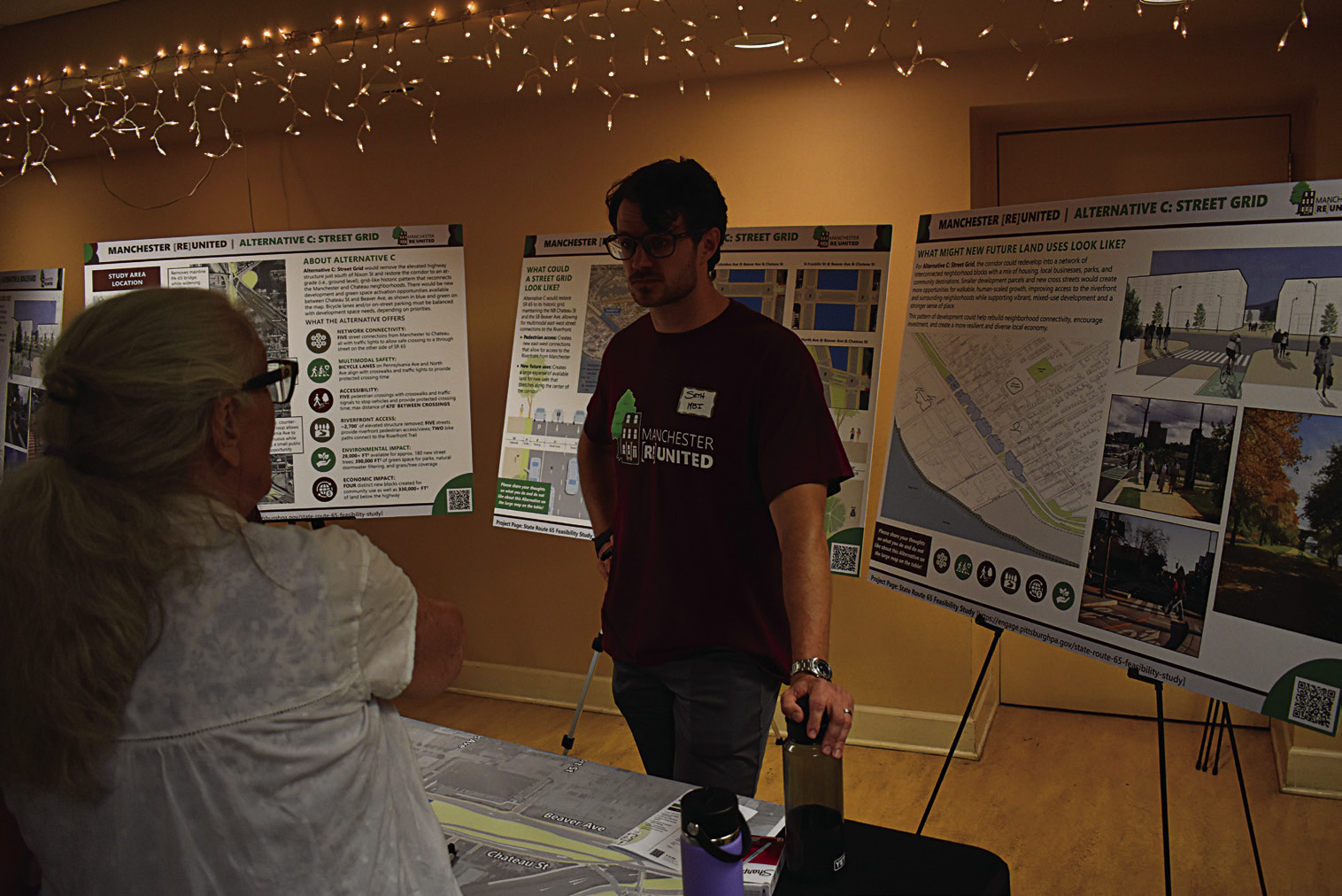
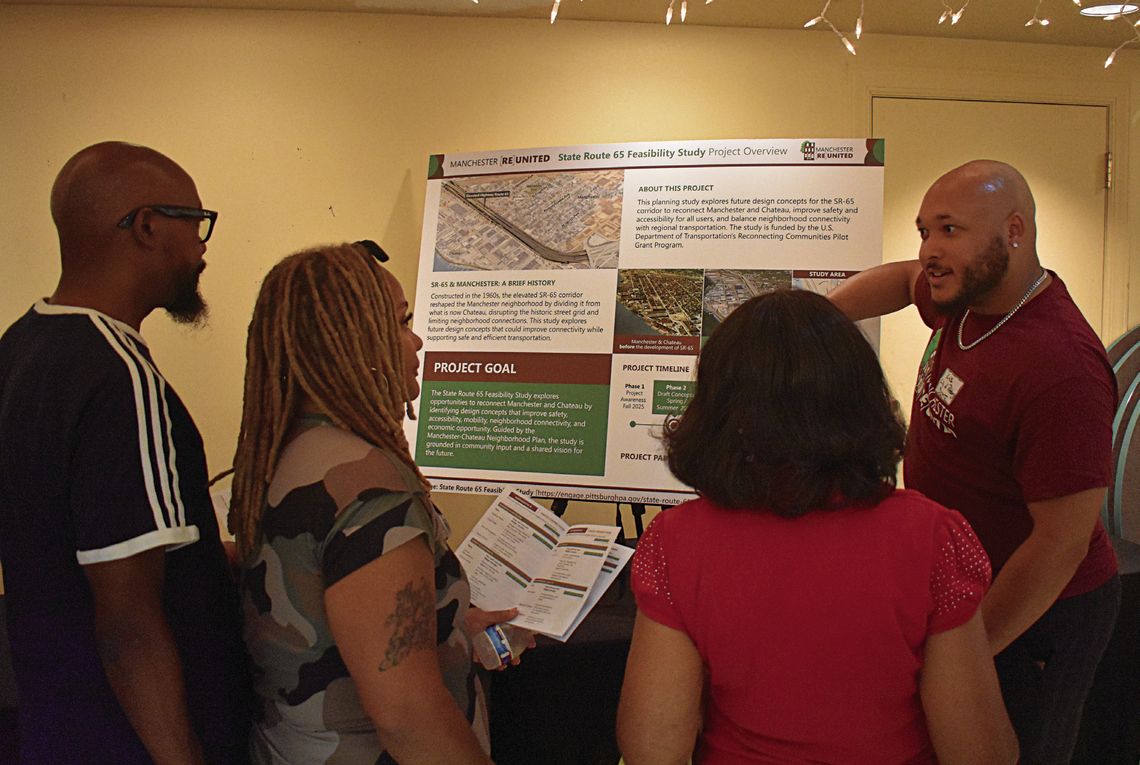
Pittsburgh’s Department of Mobility & Infrastructure (DOMI) held a public design workshop on Aug. 5 at the Manchester Citizens Corporation to allow attendees to review three plans to transform State Route 65 and reconnect Manchester and Chateau. Despite a heavy rain storm occurring that day, the event drew a packed crowd of people to give their feedback.
Beginning construction in 1960, a 1-mile portion of State Route 65 bisected Manchester and Chateau, leaving residents with few non-vehicular options to cross over from one neighborhood to the other, despite them being adjacent to one another.
Kris Chandler, a principal planner with DOMI and project lead, said such occurrences were common during the construction of the national highway system, saying many of these major roadways were built through Black and low-income communities, effectively cutting neighborhoods up.
The United States Department of Transportation is funding a feasibility study to lessen the barrier represented by the highway through its Reconnecting Communities Pilot Grant Program. While DOMI’s project will not definitively result in construction, Chandler said the plan is to take the feedback given by the public to inform future decisions to address the highway.
Attendees at the workshop were given score cards in order to grade the three plans presented by DOMI under a variety of criteria. In addition, DOMI is collecting feedback via the project’s Engage page, at engage.pittsburghpa.gov/state-route-65-feasibility-study.
The three plans presented by DOMI went under the names Cross Connections, Boulevard and Street Grid.
Cross Connections would keep the elevated structure of State Route 65, but would create four additional multimodal crossings beneath it, making it easier for cars, bikes and pedestrians to get from Manchester to Chateau and vice-versa. The plan would replace the foundation of the elevated highway with large pillars instead of solid concrete in order to enable these crossings, as well as allowing for the building of green spaces.
Boulevard, meanwhile, would lower State Route 65 to ground level and restrict traffic to two center-running lanes with limited access to local streets. The adjacent Beaver Avenue would also be moved farther east, creating new open land plots for development and around 200,000 square feet of green space. The plan would create six street connections from Manchester to Chateau, using traffic lights to allow for safe crossing and to slow traffic on the road.
Finally, Street Grid would remove the elevated highway and replace it with two street-level roads. This would recreate the historic street grid-like pattern between Manchester and Chateau. The plan would make five street connections between the neighborhoods, and would create four new city blocks for potential development, as well as creating around 390,000 square feet of green space.
The planning study project is lasting through the end of September.
Public reaction
The Chronicle spoke with various members of the public in attendance at the workshop to see how they felt about the plans presented.
Charis Walker, a resident of Manchester for 12 years, said she found herself leaning towards Boulevard most out of the three plans, though wasn’t strictly opposed to any of them.
“I like something about each of them,” she said.
Walker said Boulevard stuck out due to creating more space for redevelopment by shifting Beaver Avenue over.
Betsy Coleman, who has lived in Manchester for 52 years, said she favored Cross Connections, as she wanted to keep State Route 65 elevated. She thought it the most convenient for people coming and leaving from the area, as well as being the safest for pedestrians and cyclists.
Jess Jackson, a Manchester resident of 16 years, was unable to choose which was her favorite, saying all plans “have their positives.” However, she said her biggest concern was about traffic speeds with whatever plan is put into action.
Jess’s husband Drew Jackson, also in attendance at the meeting, said he most favored Street Grid, seeing it as creating the best connections between the neighborhoods while slowing traffic down the most to safe levels.
However, he said that whichever plan comes out of the study, he most hopes that it is actually taken up by the city, expressing some worry that a plan could be made but never carried out.
“I hope they come to fruition,” he said.