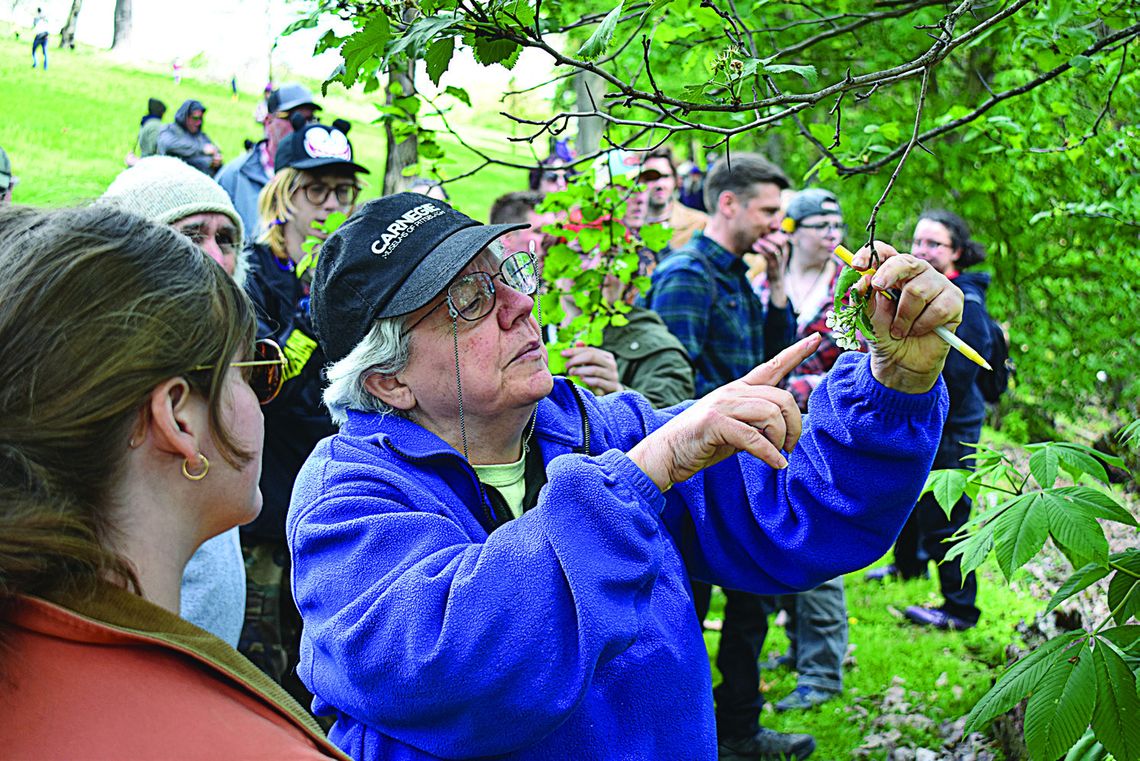
RIVERVIEW PARK —With gnarly bark and thorns sharp enough to puncture tires, hawthorn trees are an unlikely candidate to be anyone’s favorite plant. However, this genus was the center of attention at Riverview Park’s Arbor Day celebration on April 19, as visiting academics revealed just how many mysteries surround hawthorns.
Andrew Moore, author of the book “Pawpaw: In Search of America’s Forgotten Fruit” was joined by Université de Montréal Assistant Professor Étienne Léveilé-Bourret and two of Léveilé-Bourret’s students — Marc-Aurèle Vallée and Étienne Lacroix-Carignan — in presenting a lecture and accompanying nature hike focused all around hawthorns, which are also known by the genus name Crataegus.
Moore explained that hawthorns are a genus which is “rare in the world” but “locally abundant” when it comes to the Pittsburgh region. In fact, he said, there is a population of hawthorns in Riverview Park that have lived in the park for over a century.
As a result of this relative rarity, among other factors, very little research on hawthorns has been done, and not much is known about them.
Léveilé-Bourret, who is a professor of plant taxonomy and floristics and is the curator of the Marie-Victorin Herbarium, said there are 169 identified species of hawthorns across Canada and the United States. Of these, 44 are vulnerable to critically imperiled, and four are presumed extinct.
“It’s hard to prove extinction,” he said in explaining the presumed aspect.
Rather bizarrely, the plants do best in “human-affected” environments, such as parks, abandoned farms or near urban areas. In England, hawthorns native to that country were used to make hedgerows, a kind of natural fencing to separate plots of cultivated land.
Hawthorns have also seen use as flavoring in Mexico, and can be used in tea, jelly and ketchup, with attendees at the lecture getting a chance to taste two kinds of hawthorn tea, one made from leaves and the other from the tree’s fruit.
The genus has also helped medically, used to treat hypertension and digestion issues.
It is not just humans who utilize hawthorns, however. Léveilé-Bourret said the plants are famously used by shrikes, the bird species known for impaling prey upon plant spines. In fact, the thorn branches of the hawthorn have made it a favorite nesting spot for birds, as it helps to keep predators away from their eggs.
Additionally, the hawthorn’s fruits are “loved” by mammals, birds and insects.
“You have a whole ecosystem that centers around these trees,” Léveilé-Bourret said.
The genus appears to be in decline across eastern North America for unknown reasons. Some hypotheses to this decline include the spread of invasive shrubs, changes in agricultural practices which deemphasize hedgerows, and urban sprawl.
The difficulty in identifying an exact reason for the decline is in part due to the lack of knowledge about hawthorns, which are difficult to study.
As Léveilé-Bourret explained, hawthorns are capable of reproducing asexually, producing children that are like clones of the parent. This means if a hybrid of two hawthorn species is made due to sexual reproduction, it can reproduce on its own and give the appearance of an entirely new species.
In fact, the Pennsylvania hawthorn, also known as Crataegus pennsylvanica, is believed to be a hybrid of two other hawthorn species, specifically Crataegus mollis and Crataegus coccinea, which has reproduced enough times to effectively become its own species.
This difficulty in identifying hybrids versus full species, Léveilé-Bourret explained, led to scientists naming thousands of hawthorn species once research began in the 20th Century. An academic paper called “The Crataegus Problem” in 1932 identified this over-naming, and led to the reduction in the number of identified species.
Vallée explained that he is working on devising a new, more effective way to identify hawthorns in order to boost research into the genus. His proposed method would utilize leaf spectroscopy — in other words, measuring light absorption of the plant’s leaves to determine its biochemistry and structural traits.
Lacroix-Carignan closed out the talk by going over more mundane identification methods for different species of hawthorns. Notably the anthers — the part of a flower which actually produces and holds the pollen — are different colors across species, ranging from cream to palest pink to burgundy to just standard pink.
Lacroix-Carignan did caution that the colors of the anthers fade over time, and young hawthorns are needed to use this method. The number of anthers per flower can also be used to find species differences.
Other techniques include looking at various aspects of the hairs on hawthorn leaves, examining the look of the trees’ flowers, the difference in berry appearance, and even down to variance between thorns.
Lacroix-Carignan said that hawthorns can live for more than a century and grow tall quickly, but are slow in terms of lateral growth.
At the end of the lecture, the academics presented a web page via QR code that has more details on documenting hawthorns. The URL for the page is inaturalist.org/journal/marc_aurele/124387.
Moore finished up the presentation by taking attendees on a walk around Riverview Park, pointing out various hawthorns along the way.